The Easy Question
Is data valuable? Easy question, right? 🙂
The majority of people will respond with a resounding “duh.” But the real question is how valuable? Can you accurately quantify or qualify just how valuable it is to a business or in your personal life?
That’s a much more difficult question to answer, one that businesses are actively trying to figure out and the answer will vary depending on each individual’s perspective.
The other factor to consider is the recent explosion in the amount of data in the world. It's exponential!
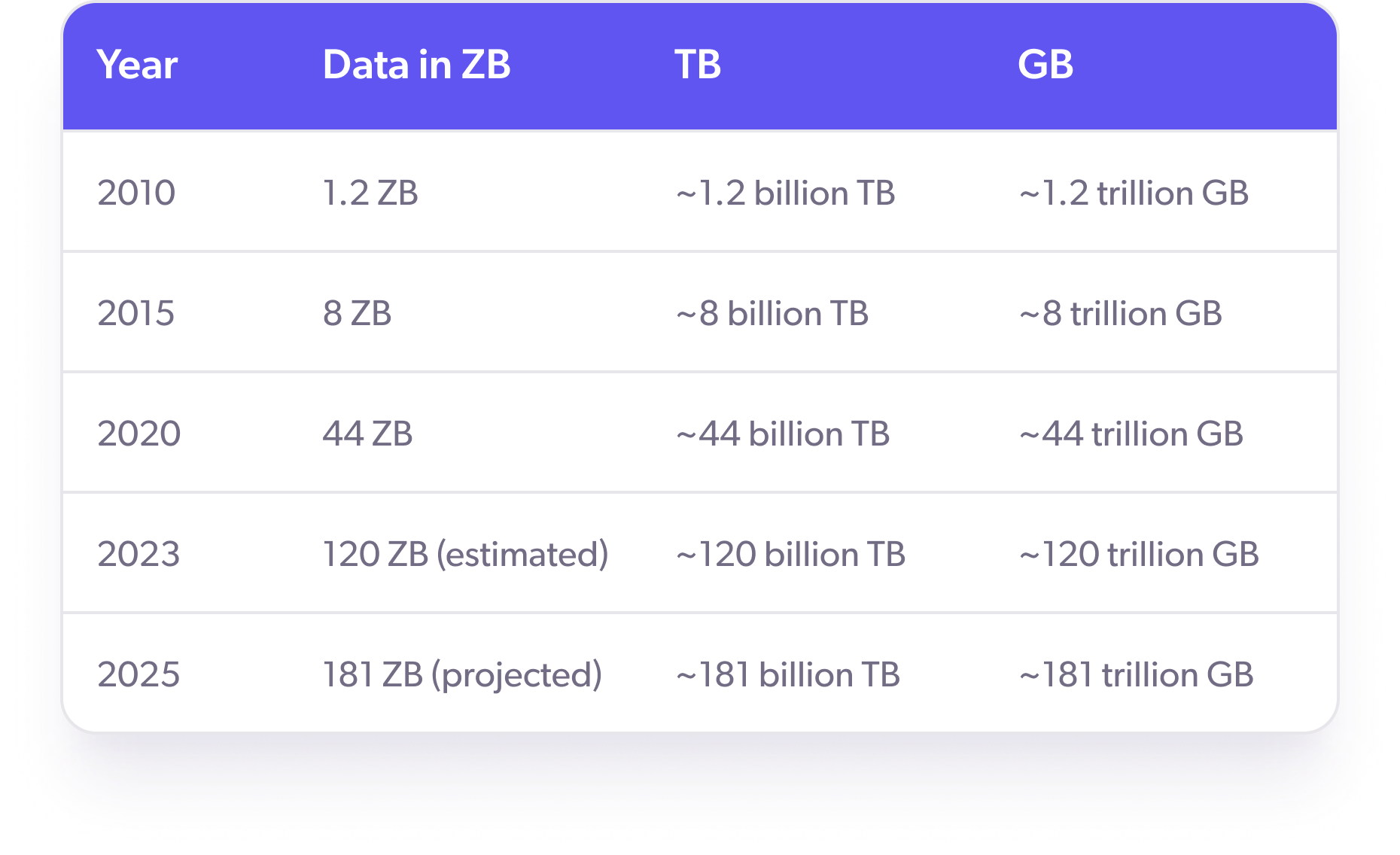
Starting in 2010 and as I write this in 2025, we can see a ~14,983% increase in global data over that period. This growth shows no signs of slowing down.
Estimated Data Growth Chart from 2010 to 2025 (below)
With this exponential increase in the sheer quantity of data, the question becomes even more difficult to calculate. There’s a high chance that a large percentage of those overall ZBs are useless to most businesses and people, especially if the data is unstructured and illegible from a systems perspective.
This Begs the Question
Are businesses achieving the full potential of leveraging data? If anyone were to wager a guess, the majority would say no, not yet.
And the reason why is surprisingly simple: dirty, uncurated, or fragmented data slows everything down.
Be it analytics, decision-making, model training, personalization, sales targeting, or even basic reporting, you can’t scale insights, automation, or intelligence if the raw ingredients are a mess. That’s like trying to assemble an airplane with only car parts.
In contrast, clean, and curated data creates a foundation that allows businesses to move faster, build smarter systems, and make more confident decisions.
Think about it this way: AI and analytics are like high-performance engines, but if you’re feeding them low-grade fuel (i.e., unrefined data), you’re never going to get the performance you expect.
Clean data is the premium-grade input that powers modern innovation.
In Short
More data ≠ better insights. Better data = exponential business value.
So yes, data is valuable, but only when it's structured, curated, and ready to work for you.
This is the mission for
People Data Labs: to create the best datasets available for businesses so they can scale and hit their goals, without having to do the heavy lifting.
PDL takes the time to clean out bad data, standardize it into a usable structure that today’s technologies can actually take advantage of while reducing complexity and making it as near turnkey as possible.
One example of clean data, something surprisingly simple: employee headcount data.
Why has this become such a debacle? Due to the presence of fake profiles and personas cluttering publicly available data.
PDL ensures that we recognize real people, highlight their actual professional presence, and filter out as many fakes as possible.
This empowers businesses, especially those focused on
investment research to accurately monitor employee growth and churn without having to constantly eyeball public websites or manually verify every single profile.
The Ultimate Question
How valuable is high-quality, cleaned/curated, normalized, and standardized data vs. vast amounts of uncleaned data? If you had $1 million, and you had to put it on one of these, where would you place your investment?
What
PDL offers, holistically, as a premium data provider is all the legwork of gathering data from thousands of sources across the public web and creating easy-to-use, comprehensive datasets that can make any analytics model, data-driven workflow, or AI leveraging it swoon.
The next time you’re building a workflow, an analytics model, a recruiting platform, an investment research platform, or the next-generation AI platform,
People Data Labs will have the best datasets on the market to help you achieve excellence.
We do the work of gathering, maintaining, curating, normalizing, and standardizing the data so you can simply take action 💪
My Recommendation
Try it out yourself by signing up for free with
People Data Labs or get in touch with a
Data Consultant. You’ll be saying things like “Who’s your data?” and “That’s what data likes” in no time.